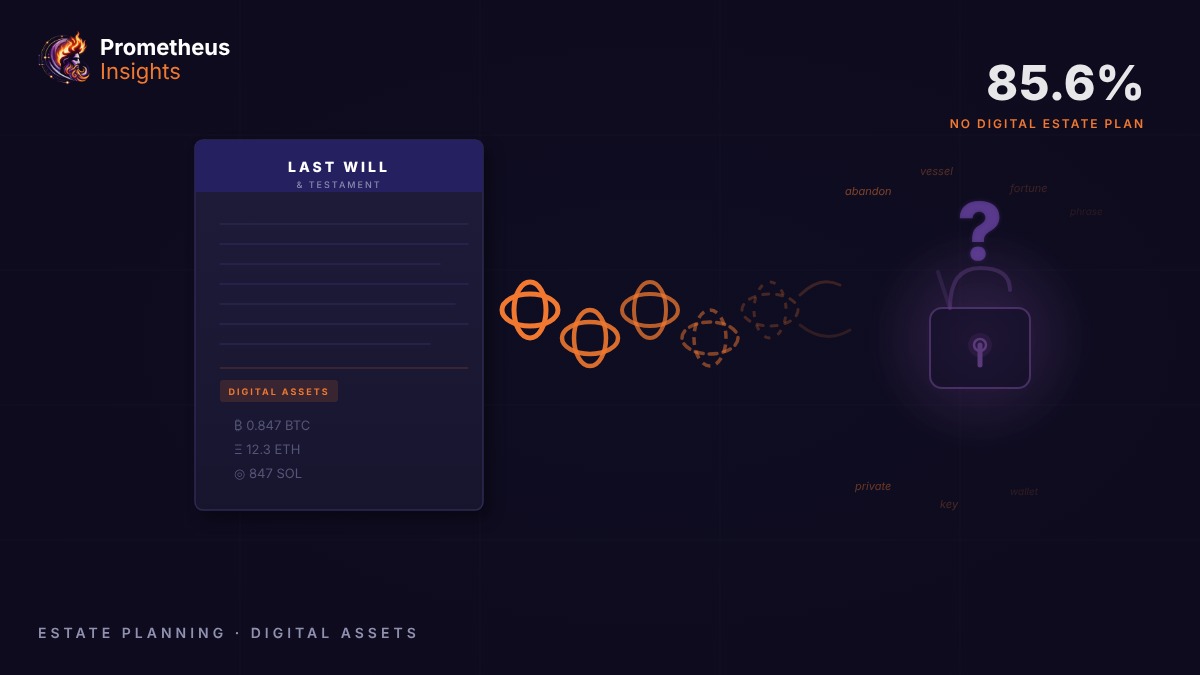
Every week, families discover that a loved one held thousands — sometimes hundreds of thousands — of pounds in cryptocurrency, and that every last coin is permanently inaccessible. Not stolen. Not lost on an exchange. Simply locked behind a seed phrase that existed only in one person's memory.
This is the defining estate-planning failure of the digital age, and it is happening at scale right now.
The Scale of the Problem
The numbers are striking. A 2026 survey of 2,000 UK adults by The Investors Centre found that 57.5% of UK adults now hold financial assets digitally — through trading apps, online ISAs, crypto exchanges and app-based savings platforms. Among that group, only a small fraction have taken any steps to ensure their families could access those assets after death.
The Compare the Market survey (2,001 UK adults, Censuswide) paints an equally stark picture. Only 10% of adults had any plan for who would inherit their digital assets. Among those aged 55 and over — precisely the cohort with the most accumulated wealth — that figure fell to just 5%. Meanwhile, 19% had not even thought about their digital legacy, and 15% had done nothing more than tell someone verbally.
The FCA's 2025 Cryptoassets Consumer Research found that approximately 4.5 million UK adults currently hold cryptocurrency — with a growing proportion holding substantial amounts. 21% of holders have between £1,001 and £5,000; 11% hold between £5,001 and £10,000. Among digital investors broadly, 17% hold £100,000 or more online.
Who Has Access to Your Crypto?
When someone dies, their estate passes to executors and ultimately to beneficiaries. With a traditional bank account, the process is cumbersome but navigable: probate, death certificate, legal authority. Banks have customer-service teams, regulatory obligations, and processes for dealing with bereavement.
Cryptocurrency is fundamentally different. No customer service team can reset a hardware wallet. No court order can compel a blockchain to release funds. If the private key or seed phrase is not documented and accessible to the right people, the assets are mathematically sealed forever.
Source: The Investors Centre survey of 2,000 UK adults, February 2026
The credential data reveals a secondary crisis. 51.5% of digital investors rely on phone-based two-factor authentication — meaning access to their accounts is tied to a single physical device. If that device is lost, broken, or simply passed to a carrier who cancels the number, exchange access disappears with it.
And 22.7% memorise their credentials entirely. When they die, so does access.
The Inheritance Tax Dimension
Even where families do manage to locate and access crypto holdings, they can face an unexpected tax problem. Cryptocurrency is treated as a capital asset under UK law, subject to both Capital Gains Tax and Inheritance Tax. HMRC has been explicit: cryptoassets form part of a deceased person's estate and must be declared for IHT purposes.
This creates a double jeopardy for unprepared estates. Executors may discover holdings they cannot access, cannot value accurately, and cannot liquidate to pay the tax bill — all within HMRC's standard deadlines. The situation becomes especially acute when:
- Assets are held in self-custody wallets with no documented seed phrase
- Holdings were spread across multiple exchanges under different email addresses
- The deceased used a hardware wallet that cannot be located
- NFTs or DeFi positions require specialist knowledge to even identify
What Blockchain Forensics Can Do
When a family suspects crypto assets exist but cannot locate them, blockchain forensic analysis can recover significant value. By tracing transaction histories from known wallet addresses, cross-referencing exchange records obtained through legal process, and analysing on-chain activity, it is often possible to reconstruct a complete picture of holdings — even where the deceased left no instructions.
Prometheus Insights has supported families and legal professionals through exactly these situations. Our investigators can:
- Trace all wallet addresses associated with known transactions
- Map assets across multiple chains and protocols
- Identify exchange accounts and support the legal process for access
- Provide court-ready reports for probate and IHT purposes
- Assess the recoverability of self-custody holdings
Forensic analysis cannot recover assets where seed phrases are genuinely lost and no on-chain trace exists — but it can frequently identify assets the family did not know about and establish the evidential trail needed for legal proceedings.
The Steps Every Crypto Holder Should Take Now
The good news is that the problem is entirely preventable. The steps are not technically complex — they simply require the same intentionality that responsible financial planning demands in any other area.
1. Conduct a complete digital asset audit
List every exchange account, wallet address, hardware device and DeFi position. Include the platform, approximate value, and the email address used to register. Store this document securely and update it at least annually.
2. Document seed phrases and private keys appropriately
Never store seed phrases digitally without encryption. Consider fireproof physical storage, a solicitor's safe, or a specialist digital vault service. The key question: if you died tonight, could your executor locate every asset and access it within six months?
3. Update your will
Standard wills do not contemplate digital assets. Work with a solicitor to include specific provisions for crypto holdings — including who receives them, who is authorised to access them on behalf of the estate, and how access instructions are to be conveyed securely.
4. Brief a trusted person
Your executor does not need to know your seed phrases in advance — but they need to know where to find the instructions when the time comes. A sealed letter with a solicitor, combined with a clear will provision, is a robust solution.
5. Seek specialist advice
Traditional financial advisers and solicitors are increasingly aware of the issue, but few have deep technical knowledge of cryptocurrency. For substantial holdings, engage a specialist who understands both the legal framework and the on-chain mechanics.
"The question is not whether blockchain forensics is needed after a loss — it's whether a family prepared well enough that it isn't. Prevention is always cheaper than investigation."
— Scott Pounder, Prometheus Insights Ltd
The Bottom Line
Approximately £1 trillion or more in UK digital wealth is currently held with no documented access pathway. That figure will grow as crypto adoption matures and those early adopters age. The families left behind will need solicitors, forensic investigators, and courts to piece together what could have been settled in an afternoon.
If you hold cryptocurrency, the most important thing you can do today is not buy more — it is to ensure that what you already hold can be found and accessed by the people you intend to benefit from it.
If you are a solicitor, financial planner, or executor dealing with a digital estate where assets cannot be located or accessed, Prometheus Insights can provide forensic analysis and expert support. Contact us to discuss your situation in confidence.
Sources
- The Investors Centre, UK Digital Estate Planning Statistics 2026, February 2026 (survey of 2,000 UK adults)
- Compare the Market / Censuswide, Most Britons lack plans for digital assets after death, reported ITBrief UK
- Financial Conduct Authority, Cryptoasset Consumer Research Wave 6, December 2025
- Chartered Insurance Institute, cited in The Investors Centre report — £5.5 trillion intergenerational wealth transfer to 2050
- HMRC, Cryptoassets Manual — treatment of cryptoassets for IHT and CGT purposes
This article is general information and is not legal, tax or financial advice. The right course of action depends on the facts of each case, and outcomes can't be guaranteed.