

When cryptocurrency is stolen, the clock starts immediately. Funds can be split across dozens of wallets, swapped into other tokens or pushed across chains within minutes. But in the early stages, stolen assets are often still sitting in a small number of wallets, or heading towards an exchange or stablecoin issuer that has the power to freeze them.
That window is the golden hour. What a victim does in it often decides whether recovery is realistic or not. This is the playbook we give to individuals and businesses who call us in the middle of an incident.
Why the first hour matters so much
Thieves know they are racing against time. A typical laundering pattern runs through four stages:
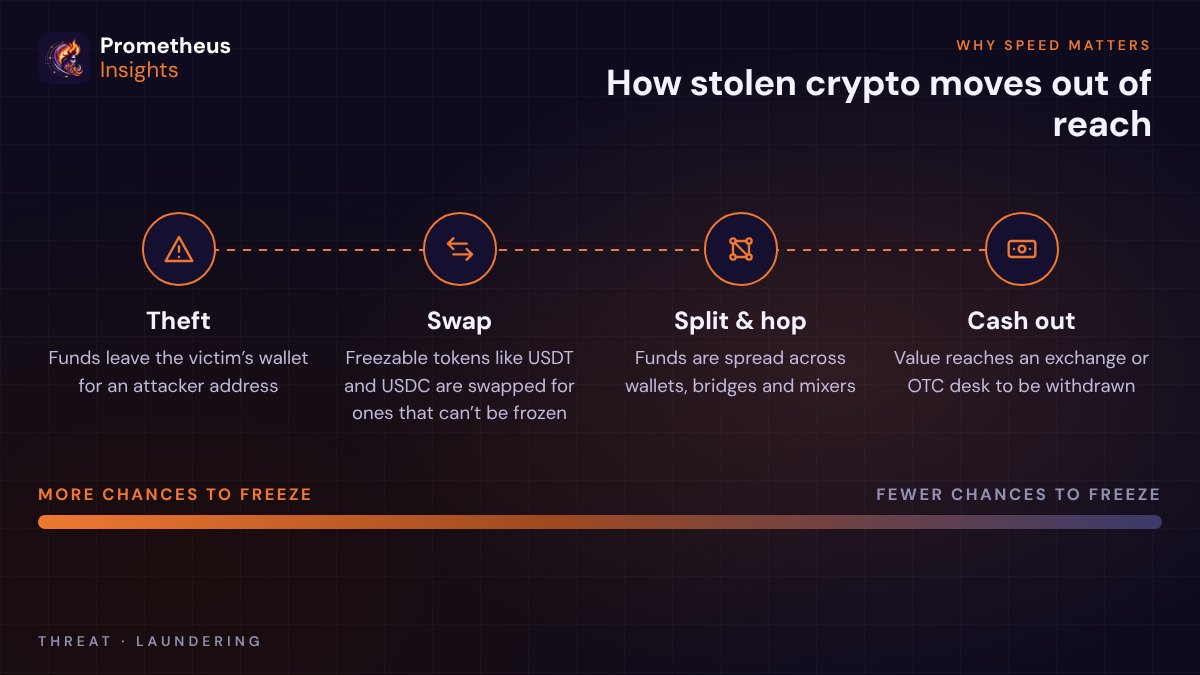
Each step makes recovery harder. The earlier the trail is picked up, the more chances there are to stop it at a point where someone can freeze the funds.
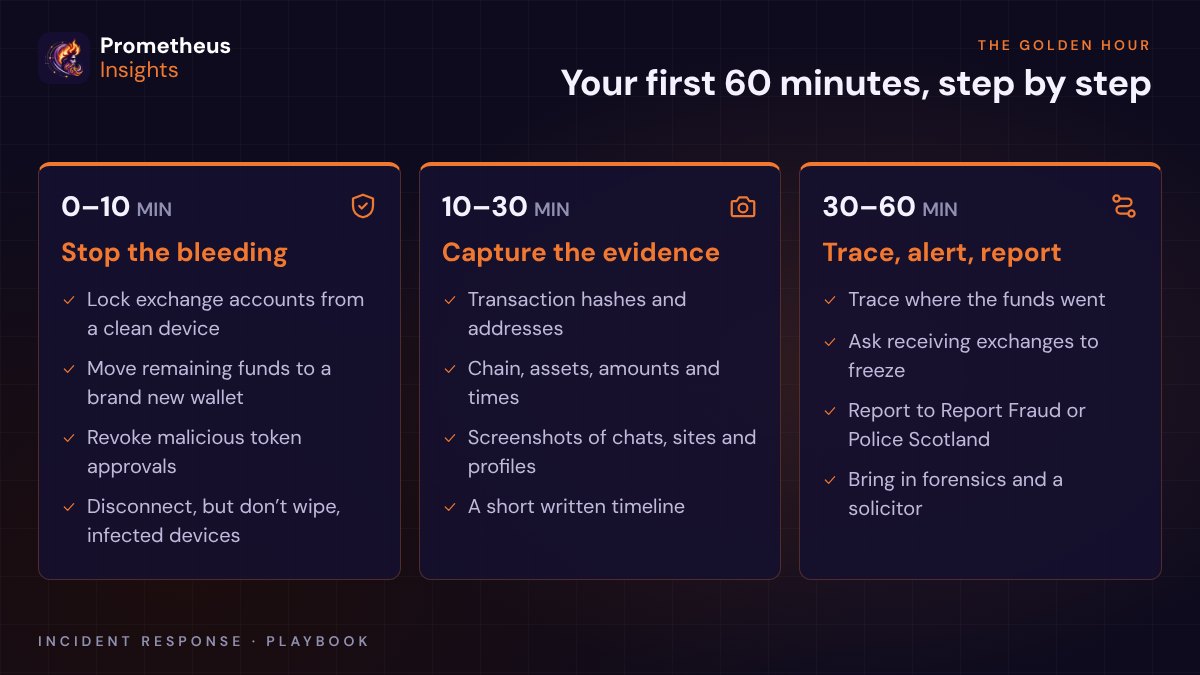
Minutes 0–10: Stop the bleeding
The first priority is to make sure nothing else is lost.
- Exchange account compromised: from a separate, trusted device, change the password, reset two-factor authentication, revoke API keys and log out all sessions. Contact the exchange's support team and ask them to lock withdrawals.
- Wallet seed phrase or private key exposed: assume the wallet is permanently compromised. Create a brand new wallet on a clean device and move any remaining funds to it straight away.
- Drained through a malicious approval: if you signed a transaction on a fake site, revoke token approvals for that wallet using a reputable approval checker, then move the remaining assets to a fresh wallet.
- Infected device: disconnect it from the internet, but don't wipe or reset it. It may hold evidence of how the attack happened.
Minutes 10–30: Capture the evidence
Investigators, exchanges and the police will all ask for the same core information. Write it down while it is fresh:
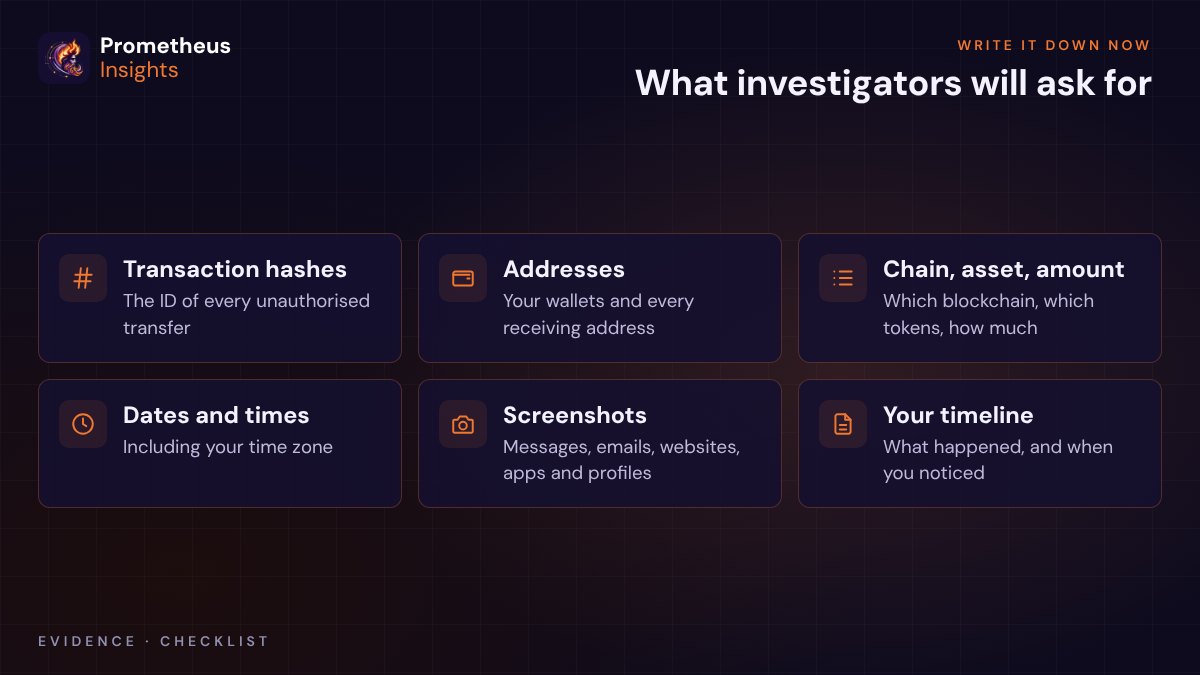
Don't delete chats or block the person involved until the evidence is saved. Every detail can help an investigator connect the theft to a real-world identity.
Minutes 30–60: Trace, alert and report
Follow the funds
A rapid trace shows where the funds have gone and where the next intervention point is. If stolen assets have reached a centralised exchange, that exchange can be contacted with the transaction details and asked to freeze the receiving account. If the funds are still held as USDT or USDC, the issuers have the ability to freeze specific addresses, usually in response to a request from law enforcement.
Report it
In England, Wales and Northern Ireland, report the crime to Report Fraud, the national service that replaced Action Fraud. In Scotland, report it to Police Scotland on 101. Keep the crime reference number, because exchanges and issuers often ask for it before they will act. Businesses should also check whether the incident triggers other obligations, such as notifying the ICO within 72 hours if personal data is involved.
Bring in specialists
A blockchain forensics team can trace the funds in real time, prepare evidence that exchanges will act on, and monitor the attacker's wallets for movement. Working alongside solicitors, that evidence can support urgent applications to the court, including freezing injunctions against "persons unknown" and orders requiring exchanges to disclose who controls an account.
What not to do
- Don't pay a "recovery" service that guarantees results or asks for an upfront fee in crypto. Recovery scams target victims within hours of a theft, often through social media replies and direct messages.
- Don't keep using a compromised wallet or device. Attackers often return for any funds that arrive later.
- Don't negotiate with the attacker alone. For businesses especially, any contact or bounty offer should be coordinated with legal and forensic advisers.
- Don't wait to see what happens. Delay is the attacker's biggest advantage.
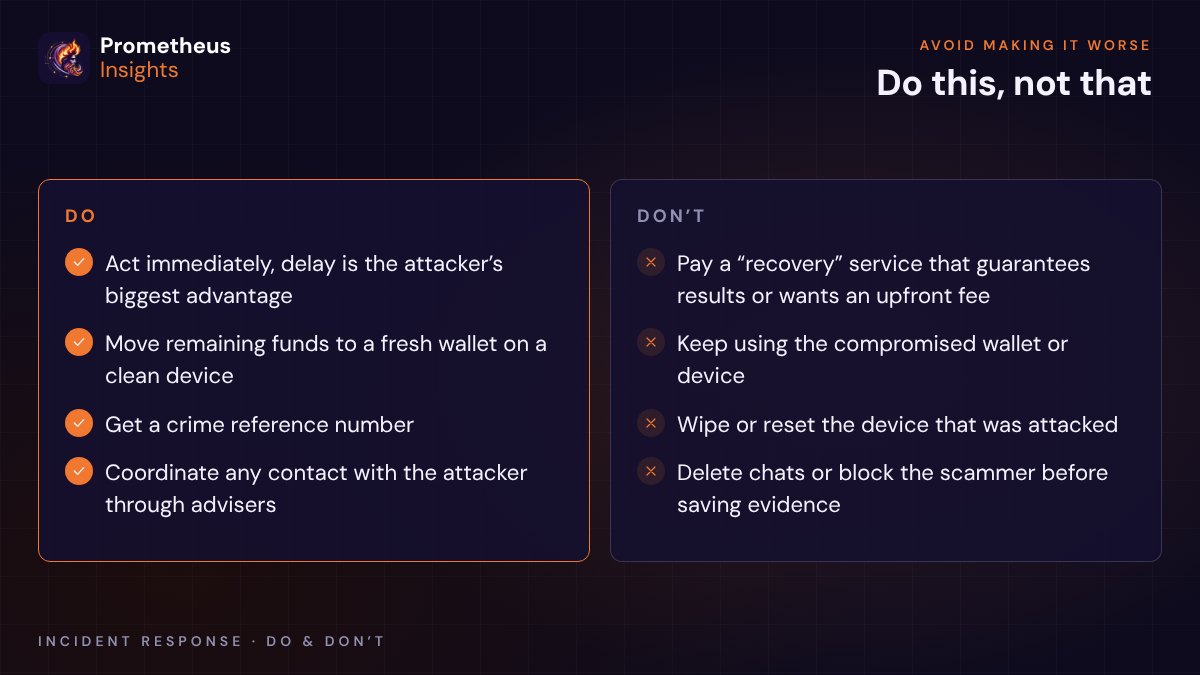
Delay is the attacker’s biggest advantage. If you have just lost crypto, act now and ask questions as you go.
For businesses: prepare before it happens
The organisations that recover best are the ones that planned for the golden hour in advance. A crypto incident response plan should cover:
- who has authority to act and who must be told
- pre-agreed contacts at your exchanges, custodians and forensic provider
- how keys and signing devices are stored and who can access them
- how evidence is preserved and who leads communications
- regular testing, so everyone knows the plan before they need it
The golden hour checklist
- Secure accounts and move any remaining funds to a clean wallet
- Record transaction hashes, addresses, amounts and times
- Save screenshots and messages, and keep the device for evidence
- Contact any exchange that received the funds
- Report to Report Fraud or Police Scotland and keep the reference number
- Bring in a blockchain forensics specialist and a solicitor
- Ignore anyone promising guaranteed recovery for an upfront fee
How Prometheus Insights can help
Prometheus Insights provides 24/7 emergency response for crypto theft, hacks and fraud. We trace stolen funds across more than 50 blockchains, engage exchanges and issuers, monitor attacker wallets in real time, and produce the evidence your legal team needs to seek freezing and disclosure orders.
If you have just lost cryptocurrency, or you are advising a client who has, contact us straight away at prometheus-insights.com. In a crypto theft, every minute counts.
This article is general information and is not legal advice. The right response to any incident depends on its facts, and outcomes can't be guaranteed.